


How do you pick a venue before you know your guest count?
Three numbers are enough: a low, an expected and a high guest count, and a venue that works at all three. Then check its minimum, its comfortable seated capacity and how many guests it can sleep.
You do not need confirmed replies to choose a venue. Write down a low, an expected and a high guest count, using published attendance estimates for the expected number, and pick a venue whose minimum sits at or below your low and whose comfortable capacity sits at or above your high. Then read the contract for the final headcount date and, abroad, for how rooms are counted.
In this guide
At a glance
- Numbers to bring
- A low, an expected and a high guest count
- Capacities to ask for
- Minimum, comfortable seated capacity, sleeping capacity
- Attendance estimates
- About 35% to 75% of invited guests
- Contract terms to read
- Headcount lock date, room attrition
How do you estimate a guest count before anyone replies?
Write down three counts instead of one: a low, an expected and a high. Dream Ranch, a US event venue, suggests a minimum, expected and maximum count before you contact venues, and a commenter in r/DestinationWeddings suggests an A, B and C list: definitely coming, hopefully coming and probably not. destinationweddings.com sorts the list the same way and assumes nearly all of the first group, a bit under half of the second and very few of the third.
For the expected number, use the attendance estimates in how many guests actually come to a destination wedding, which run from about 35% to 75%. At 120 invitations, 50% is 60 guests and 70% is 84, so a venue that is comfortable from about 60 to 90 covers the likely outcomes. That is arithmetic on published estimates, not a prediction.
You do not have to ask anyone first. One r/weddingplanning commenter told a couple whose venue wanted a number to draw up a mock guest list with their partner, since attendance does not have to be confirmed with anyone. If a venue needs a figure to quote, give your expected count and ask for prices at the low and high as well.
What should you ask a venue about capacity?
Ask for more than one number, because the maximum a venue advertises is rarely the one that works for you. These are the questions to put in writing.
| Ask | Why it matters |
|---|---|
| Minimum guest count or spend | The Knot says venues set headcount minimums and maximums. Stay well above the minimum so that no-shows do not put you under it. |
| Comfortable seated capacity with a dance floor | A venue’s maximum and the number it holds comfortably are different. One venue guide says to ask for seated capacity with the dance floor, bars and service space included. |
| Ceremony and reception capacity | They can differ, and so can the plan for bad weather. |
| Whether the layout can shrink | One venue says a room built for 250 feels empty with 80. Ask what changes at your low number. |
| Final headcount date and how far you can reduce it | One contract-review app’s guide to US catering contracts suggests a lock closer to the date and the right to cut the count by up to 10%. A couple in r/weddingplanning said their caterer only lowered the price once the headcount fell 10% below the original. Terms differ by venue. |
Venues in Italy, Greece or Mexico may word these differently. Ask the same questions and get the answers in writing.
Does the venue also need to sleep your guests?
At a destination wedding it often does, so you are choosing two capacities: seats and beds. A villa-rental company says on-site sleeping at private villas typically covers 12 to 30 guests, while ceremonies and receptions can host 50 to 100 or more. Another venue guide advises asking how many guests can sleep on site, counted in private bedrooms and not as maximum occupancy.
Rooms add their own commitment. A room-block contract usually has an attrition clause, which sets how many rooms must be booked and what you owe if guests book fewer. The planning company Yellow Umbrella Events says the couple pays the shortfall. Ask for the attrition percentage, the release date and the room cancellation window before you sign, and read who pays for guests’ rooms at a destination wedding before you commit to a block.
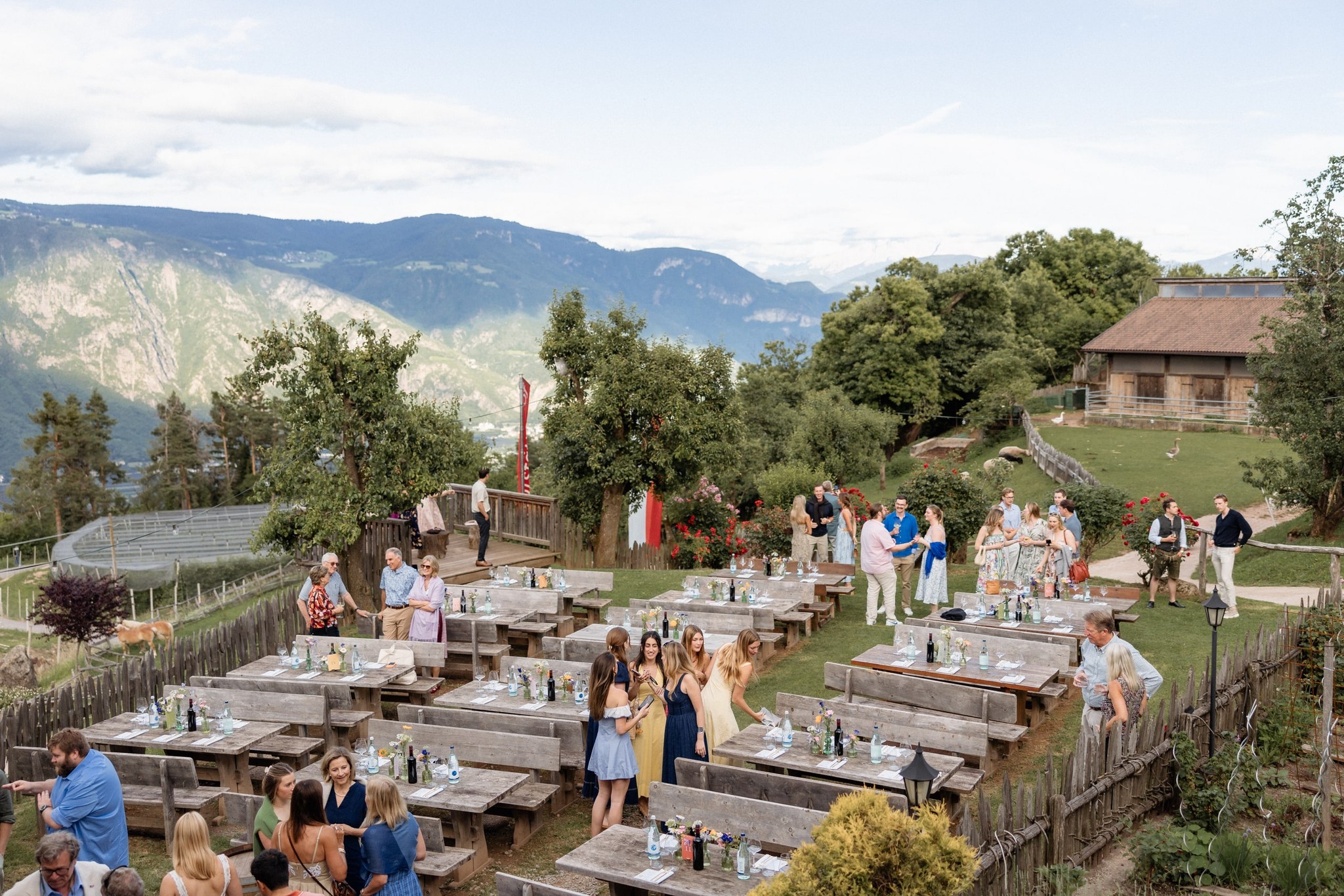
Aisle’s founders met this at their own wedding at Castel Fragsburg in Merano, Italy. The hotel sent them one bill for everything, and collecting guests’ room payments is what led them to start Aisle. On an Aisle wedding website, guests can book and pay for their own rooms.
What if you have to book before you know anything?
Choose the venue that works across your range and read the contract for what happens at the edges. Advice on which way to lean is mixed. One r/weddingplanning commenter recommends a venue that fits everyone you want to invite, then inviting in phases as people decline. Another warns against a venue whose maximum barely holds your list or sits just under it.
The Knot says never to invite more than your venue can handle, even counting a B-list, and suggests sending the A-list first and a B-list as declines arrive. destinationweddings.com says a space that looks right at both 25 and 45 guests is worth more than one that is perfect at exactly 40, and that package minimums are negotiable at booking and painful to unwind later.
If you plan a B-list wave, send it early. In a 2023 Shane Co. survey of more than 3,000 Americans, 73% said they need at least five months’ notice to save the date for a destination wedding.