





Who pays for guests’ rooms at a destination wedding?
Guests are usually expected to pay for their own rooms. The couple pays when they require guests to stay at a set place, or when they choose to host the wedding party or close family.
Guests pay for their own rooms at most destination weddings, and the couple pays for their own. Couples cover other rooms by choice, usually for the wedding party, close family or a small group in a rented house, or because the venue requires everyone to stay there. The couple also carries the risk on any block of rooms they sign for, so what guests do not book can become the couple’s bill.

In this guide
At a glance
- Usual rule
- Guests pay their own rooms
- Couple usually pays
- Their own rooms, hosted events
- Couple often carries
- Unbooked rooms in a block
- Aisle’s modelled bedrooms, Italy
- $4,500 for 80 guests
Who usually pays for guests’ rooms?
Guests do. A venue owner quoted by The Knot says wedding guests, wedding party included, traditionally cover their own hotel rooms, which lets each person choose a room that fits their budget. WeddingWire’s guide to destination weddings gives the same split: guests book and pay for airfare, rooms and extras, while the couple or their parents pay for the venue and vendors. A Practical Wedding calls guests paying for their own rooms simply how things are done.
The same pattern holds in the UK. Hitched says guests traditionally pay for their own accommodation, and that covering rooms for family or the wedding party is generous but usually kept for special cases. For the wider picture of who pays for what, see who pays for the wedding and destination wedding etiquette.
When does the couple pay for rooms?
The couple pays in a few situations, and most of them are a choice rather than a rule.
- Their own rooms, and any suite used to get ready in.
- Rooms for the wedding party or close family, as a thank-you. The Knot’s planners say this is not expected, and happens more often at small weddings or when a couple rents a villa and invites the wedding party to stay.
- Rooms for one or two guests who could not otherwise come. WeddingWire’s guide says this can stay a private matter.
- Rooms for everyone, when the venue or the couple requires guests to stay on site. Opinion splits here. Commenters in an r/BigBudgetBrides thread argued that a required stay should be paid for by the couple, while several commenters in an r/DestinationWeddings thread said they would not expect the couple to pay at all.
If you do cover rooms for some people, do it quietly and use one rule for everyone in the same group, so nobody finds out they were treated differently.
Who carries the risk when guests do not book?
The couple does, if they signed a block with a minimum. Many block contracts include an attrition clause, which sets a share of the block you must fill by a cutoff date, typically 30 days out (Groups360). Kuoni Tumlare, a congress accommodation firm, writes that in the US, organisers fill 80 to 90 per cent of the rooms or pay a penalty, while the European congress model often lets the organiser release unsold rooms by agreed dates. Both sources describe conference blocks, not wedding contracts, so ask your venue which kind you are signing.
A guest posting in r/weddingplanning described a Mexican resort that required at least 80 per cent of wedding guests to stay on site, with the couple getting up to $2,000 off depending on rooms booked. That is one report, not a rule, but it shows the trade: a small perk to the couple, and a minimum that guests have to meet.
Aisle’s wedding cost index models the bedrooms a couple must commit to, which guests usually pay back. In Aisle’s modelled estimate for 80 guests, that figure is $4,500 for Italy, $6,700 for Greece and $32,000 for Mexico, taken as the median across the venues modelled. These are modelled estimates, not venue quotes. See the destination wedding cost index for how it is built.
How do you collect room money from guests?
The simplest way is to let guests book and pay the hotel themselves at the group rate, and to keep your own contract free of a minimum where you can. If the venue only sells rooms through you, you collect from guests and pay the hotel, which means chasing deposits and tracking who owes what.
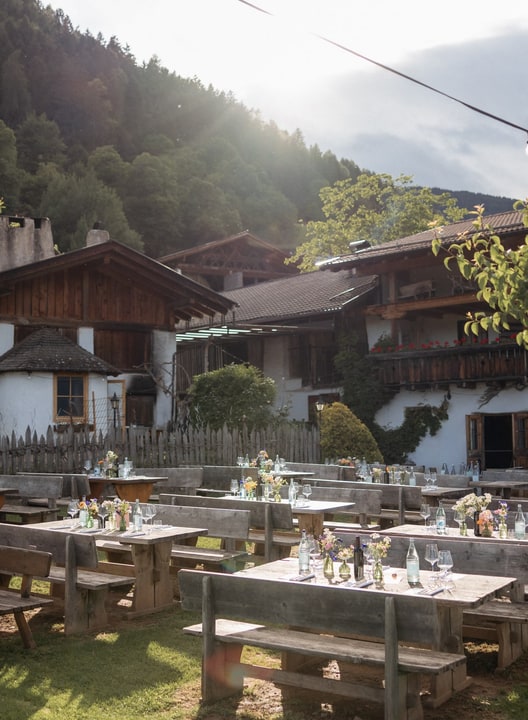
At their own wedding, Aisle’s founders, Walt and Perrie, married at Castel Fragsburg in Merano, Italy. The hotel sent them one bill for everything, and collecting their guests’ room payments is what led them to start Aisle. On an Aisle wedding website, guests can book and pay for their own rooms, which is described in guest room booking.
Whichever route you take, tell guests early and in writing. A destination wedding agency’s blog recommends putting the nightly rate, the minimum stay and the room block deadline on the save the date. Guests can then plan around a real number. One commenter in r/DestinationWeddings said they subsidised rooms, covered them fully for guests who needed it, and explained the setup to everyone. A guest in another r/DestinationWeddings thread found the resort’s own price lower than the couple’s booking link, so say whether guests may book elsewhere and what that changes for you.