
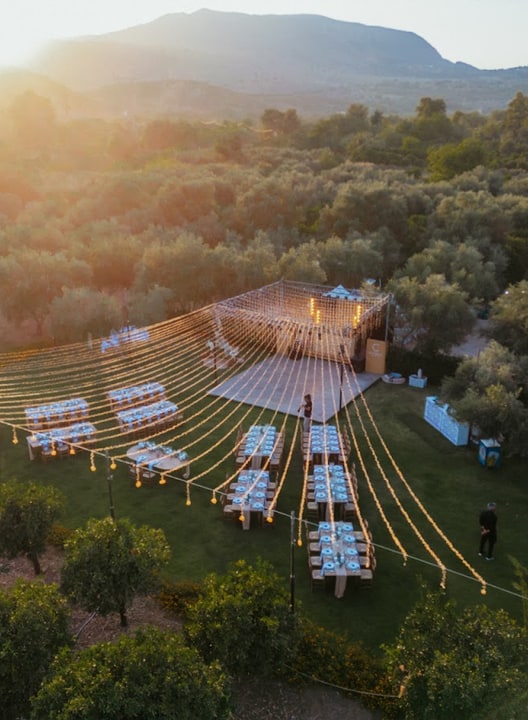




How do you make a wedding seating chart?
Seat the couple, wedding party and close family first, group everyone else by relationship, and fit the groups to tables of 8 to 10 once RSVPs are in.
Start with the couple, the wedding party and immediate family, then sort everyone else into groups of people who know each other, such as college friends or work colleagues. Fit those groups to your venue’s floor plan and table sizes (suppliers quote 8 to 10 seats for a large round table, and they differ), and finish once your RSVPs are in. The Knot says a seating chart is a must for weddings above about 50 guests.

In this guide
At a glance
- Seating chart needed
- Above about 50 guests (The Knot)
- Seats per round table
- 4 to 12 by size; 60 and 72 inch tables are quoted at 6 to 10
- Start with
- Couple, wedding party, immediate family
- Final headcount to caterer
- Usually 7 to 14 days before (Paperlust)
What are the steps to make a seating chart?
Make the chart in five passes, starting with the people whose seats are fixed. The Knot’s steps are to start early, get your venue’s floor plan, pull your guest list with replies, divide guests into groups, and stay flexible.
- Get the floor plan. Copy it so you can try layouts. The Knot says older guests should not sit too close to the music, guests who use wheelchairs need clear access to the dance floor and the exit, and immediate family and the wedding party should sit near the dance floor because of toasts and special dances.
- Seat the fixed people first: the two of you, the wedding party and their dates, and immediate family.
- Group everyone else by relationship, such as extended family, college friends, childhood friends and colleagues. Leave the hard-to-place guests until you see where there is room.
- Place each finished group on the floor plan. The Knot suggests writing lightly in pencil so you can make changes.
- Expect last-minute changes. The Knot says you will probably get at least one call asking you to move someone, and that most people mingle after dinner anyway.
You can start early without names. A planner quoted by The Knot started tentative tables as soon as invitations went out, adjusted as replies came in, and had most of the work done about two months before the wedding.
How many people sit at each table?
How many people sit at a round table depends on its diameter and your venue’s layout: the two suppliers below quote 4 to 6 seats for a 48-inch table and 6 to 12 for 60 and 72-inch tables. They do not agree on a 60-inch table, so ask your venue or rental company what it seats for a plated dinner.
| Round table | Chiavari (chair and table seller) | Ventura Rentals (rental company) |
|---|---|---|
| 48 inch | 4 to 6 comfortably | 4 to 6 |
| 60 inch | 8 comfortably; many rental companies say 8 to 10 | 6 to 8 |
| 72 inch | Up to 10 to 12 comfortably | 8 to 10 |
Ventura says capacity also depends on chair width, centerpieces and service style, and Chiavari says ten chairs at a 60-inch table would be rather intimate.
Who sits where?
There is no fixed protocol, and The Knot’s advice is to be considerate. It recommends these:
- Seat people with at least some of their dinner companions. Most guests are more comfortable with people they know, though a few new faces at a table is fine.
- Skip the singles table. One planner quoted by The Knot says it can embarrass guests, and suggests mixing single guests in with couples and friends.
- Do not separate couples with a tall centerpiece or put them across the table.
- Put a guest who knows nobody near people with similar interests.
- Put a kids’ table near the children’s parents.
- If parents are divorced, each can host their own table, with close family and friends.
- If you do not know your parents’ friends well, let your parents and future in-laws arrange those tables.
The Knot recommends listing guests alphabetically with the table number beside each name, especially for large groups. It also separates three things: place cards sit at the table for a specific seat, escort cards near the entrance tell guests their table, and a seating chart lists every guest with a table. You do not need all three.
When should you finalize it?
Finalize it after your RSVP deadline and before your caterer’s deadline. The Knot suggests setting the RSVP deadline about four weeks before the wedding. Paperlust, a stationery retailer, says most caterers and venues need a final headcount 7 to 14 days before the event, and that escort cards and printed charts need production time as well. Check the date in your own contract rather than assuming.
The chart also depends on who has answered. Reply wording and plus-one seats are in how to word a wedding RSVP, and chasing silence is in what to do when guests do not RSVP.
What changes at a destination wedding?
The chart is the same, but replies have to come in earlier and you often seat guests who travelled together. Paperlust’s destination page suggests an RSVP deadline 10 to 12 weeks before the wedding, because guests have flights and rooms to settle first. That is a retailer’s advice, not a rule, so check it against your venue’s headcount deadline.
On an Aisle wedding website, guests can RSVP per event with meal choices, so the table chart and the meal count can come from the same replies. For guest rooms, see guest room booking.